Module 03
Component Identification & How Each Part Fails
What you’ll be able to do
Identify a component without confusing its marking, nominal value and measured condition.
Course plan & prerequisites · Scope and sources · Revision 2026-09-10
On this page
Study an annotated diagram
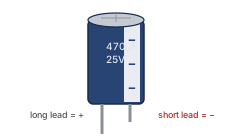
Upright cylinder in a colored sleeve with a light stripe of “−” marks running down the can on the NEGATIVE side; the shorter lead is negative, and the top is scored with a vent cross. Bulk energy storage and power-rail filtering. Failure modes: dried-out electrolyte (high ESR), and the dead giveaway — a bulged or leaking vent top. DMM check: capacitance mode for value, but a normal-reading cap can still have bad ESR — use an ESR meter; in-circuit, a rail shorted to ground points here too.
Open visuals/02-component-gallery.html ↗ in a browser — it's the picture book for this module (drawn images of every package, color-code chart, polarity table). This module is the text: what each part is, how to read it, and how it fails, because in repair, knowing the failure habits of each species is half the job.
1. Resistors
Through-hole: tan/blue cylinders with color bands. 4-band = value(2) + multiplier + tolerance. 5-band (precision) = value(3) + multiplier + tolerance. Colors: black 0, brown 1, red 2, orange 3, yellow 4, green 5, blue 6, violet 7, gray 8, white 9; multiplier gold ×0.1, silver ×0.01; tolerance brown ±1%, gold ±5%, silver ±10%. Example: yellow-violet-red-gold = 47 × 100 = 4.7kΩ ±5%.
SMD chip resistors: marked with codes — 472 = 47×10² = 4.7kΩ; 4702 = 47kΩ (4-digit, 1%); 0 or 000 = zero-ohm jumper; R10 = 0.10Ω. Tiny 0201/0402 parts are unmarked — use the BOM.
Failure habits: resistors mostly fail open (or drift high), usually from overload — and an overloaded resistor is often the victim of a short elsewhere. A burnt resistor answers "what died?" but you must still answer "what killed it?" before powering up a new one. Current-sense and fusible resistors are designed to be the sacrifice.
2. Capacitors
| Type | Looks like | Polarized? | Failure habits |
|---|---|---|---|
| Aluminum electrolytic | Cylinder/can, stripe = NEGATIVE | YES | A plausible wear-out mechanism: dries out with age/heat → capacitance drops, ESR rises → ripple, instability. Bulged or vented top = dead, replace. Can also short. |
| Tantalum | Orange/yellow bead or brick, stripe = POSITIVE (opposite of electrolytic!) | YES | Fails short, sometimes ignites. A burnt crater on a board is often a tantalum. Common on aerospace boards. |
| MLCC ceramic (SMD) | Tiny tan/brown unmarked brick | No | Cracks from board flex or thermal shock → intermittent or short. The crack can be invisible. A shorted MLCC on a rail is the classic "rail reads 0.5Ω to ground" fault. |
| Ceramic disc | Orange disc, 104-style code |
No | Robust; occasional cracks/leakage. |
| Film/box | Yellow/red box | No | Very reliable; self-healing types lose capacitance gradually. |
Marking code: 104 = 10 × 10⁴ pF = 100nF. 223 = 22nF. Letters after = tolerance.
DMM checks: capacitance mode out of circuit; in-circuit, a cap should not be a short (charging behavior in ohms mode: reading climbs as it charges). High ESR needs an ESR meter or scope (excess ripple).
3. Inductors, beads, transformers
- Inductors — coils, sometimes look like fat resistors (with color bands) or little cubes. Fail open (broken wire) or short turns (hard to detect; usually found by circuit misbehavior). DMM: should read low ohms consistent with the datasheet or BOM — small chokes read near zero, but high-value or coupled inductors legitimately read tens to hundreds of ohms; open = dead.
- Ferrite beads (FB) — look like SMD resistors, marked in Ω at 100MHz. They are continuity at DC. An open bead silently kills the rail it feeds.
- Transformers — check each winding for continuity; isolation between windings should be open (megohms).
4. Diodes
- Rectifier (DO-41 etc.) — black cylinder, band = cathode, matching the bar on the symbol.
- SMD diodes (SOD-123, SMA/SMB/SMC) — band = cathode. Marked with cryptic codes; check BOM.
- Zener — often small glass body. Tests like a normal diode forward; its reverse breakdown (the useful spec) needs applied voltage above its rating to verify.
- LED — flat side / shorter lead = cathode. DMM diode mode lights it dimly (Vf 1.6–3.3V; blue/white may exceed some meters' test voltage).
- TVS — protection device across inputs or rails; can fail short, open or leaky. Identify unidirectional or bidirectional construction before interpreting diode mode. A failed TVS does not prove a transient occurred or that downstream circuitry survived. Confirm the part using the specified isolated test and retest the protected circuit.
- Failure habits: diodes fail short more often than open. Diode test both ways: ~0.5–0.7V one way, OL the other = healthy silicon. Low both ways = shorted. Schottky reads 0.15–0.45V — that's normal, not a defect.
5. Transistors
- BJT (TO-92, SOT-23, TO-220...): two junctions. Diode-test B-E and B-C: both should read like diodes one way (NPN: + on base). C-E should read open both ways (except parts with a built-in collector–emitter diode or a Darlington's internal resistor paths). Shorted C-E is the common death. ("Body diode" is a MOSFET structure, not a BJT one.)
- MOSFET: gate-to-anything should be open (it's a capacitor); D-S shows the body diode one way. Fails D-S short typically. Gate oxide is ESD-fragile — handle with discipline.
- Pinouts vary by part number — never assume; check the datasheet. TO-220 tabs are usually electrically connected to the middle pin (drain/collector) — they are live.
6. ICs and packages
Identification = package + topside marking → datasheet. Packages to know on sight (drawn in the gallery): DIP, SOIC, TSSOP, QFP, QFN, BGA, SOT-23, SOT-223, DPAK/D2PAK, TO-220/247.
- Pin 1: dot/notch; numbering counterclockwise from top view.
- QFN/BGA: joints partly or fully hidden → visual inspection can't clear them; X-ray or boundary scan (a built-in test bus inside the chips, covered in Modules 07 and 09) territory. BGA failure habit: cracked solder balls from thermal cycling → intermittent, flex-sensitive faults.
- IC failure habits: ESD/overvoltage on I/O pins (dead input/output, rest works), latch-up, internally shorted rails (chip gets hot fast — your finger or an IR camera finds it), cracked internal bond wires (intermittent with temperature).
7. Electromechanical & hardware
- Connectors — a practical early inspection point: bent/recessed pins, fretting corrosion, cracked solder tails from cable strain. Always inspect connectors early. Aerospace circulars (MIL-DTL-38999 family) are keyed and torqued — note insert arrangement and pin gauges.
- Relays (K) — coil resistance per datasheet (typically tens–hundreds of Ω); contacts pit and stick. Click ≠ contact closed; verify with continuity.
- Switches — verify contact resistance near 0Ω; oxidation causes ohms and intermittents.
- Crystals/oscillators (Y) — crystals are mechanically fragile: a dropped board with a dead clock = suspect the crystal. Can't fully test with DMM; scope the oscillation (see 07 — Digital Board Troubleshooting).
- Fuses — verify with continuity, not eyeballs (the element can fail invisibly). A blown fuse is a symptom; find the load that blew it.
8. Board-level structures (faults that aren't "components")
- Vias — plated barrels connecting layers. Cracked via barrels from thermal cycling are a classic aerospace intermittent: works cold, fails hot (or vice versa), responds to board flex.
- Traces — can crack at flex points or burn open (a "fuse" you didn't order). Look for the subtle brown line.
- Solder joints — cold joints (gray, lumpy), cracked joints (annular ring around a lead, visible under magnification), insufficient/excess solder, tombstoned SMDs. Use the assembly's actual defect history to rank these possibilities.
- Conformal coating — the clear protective layer over aerospace boards. It hides defects, blocks probes (probe at test points or pierce per approved procedure), and must be repaired after rework per IPC-7711/7721 (10 — Aerospace Standards, ESD, and Workmanship).
- Contamination/corrosion — flux residue (white haze), electrolyte, salt/humidity dendrites that grow conductive shorts between traces.
9. The polarity table (recite it cold)
| Part | Mark | Means |
|---|---|---|
| Aluminum electrolytic | Stripe on can | Negative lead |
| Tantalum | Stripe/bar | Positive lead ⚠️ opposite of electrolytic |
| Diode | Band | Cathode |
| LED | Flat side / short lead | Cathode |
| DIP/SOIC/QFP | Dot or notch | Pin 1 |
| BGA | Corner mark | Ball A1 |
Backwards installation of any of these is both a thing you must never do in rework and a thing to check for on a failed unit — assembly errors escape into the field.
10. Drill (daily, week 3)
- Decode 10 random resistor color codes and 5 SMD codes per day until instant.
- From the gallery HTML, cover captions and name each package.
- Recite the polarity table and the "failure habits" of: electrolytic, tantalum, MLCC, MOSFET, TVS, via.
Next: 04 — DMM Mastery
Worked example & practice
Example: A resistor marked 1002 encodes 10 kΩ. A 13.3 kΩ reading is not proof of the wrong part: 13.3 kΩ is a standard value. Verify marking, BOM, measurement method and isolation.
Your turn: Find a resistor, polarized capacitor and IC in the gallery. Record what the marking proves and what still needs a datasheet.
Check: Can you distinguish identity evidence from failure evidence?
Open the annotated Component Gallery guide · Guided physical practice
Module quiz
10 questions drawn from this module. Pass is 80% — retake as often as you like; your best score is kept on this device.